There are many ways to classify soup, whether it be
a classic velouté thickened with a liaison, a purée
of lentils with ham hock stock or a broth with a
clear liquid; even the crystal clarity of consommé
still graces our modern restaurant tables. However,
the fundamental foundation of today’s dining is a
lighter and more sophisticated approach. Therefore, a
combination of the above, with a careful approach to
thickening, will yield a light and flavoursome soup.
The principles of soup making
Though the perfection of soups can take experience,
the basic principles of soup making are quite simple te
follow.
Most soup making begins by preparing a stock (se=
above).
The underlying flavours of a broth’s foundation
ingredients are enhanced by the herbs and
seasonings added. In many cases, this flavour base
begins by preparing a mixture of flavouring elements
cooked in a little fat or oil; because of their aromatic
properties and flavours, most soups begin this phase
with a combination of onion, garlic, leeks and carrots
(this is called a mirepoix) or aromats. The resulting
broth is the foundation of all soups.
Health-conscious eaters should look for clear broth
soups containing vegetables, beans and lean protein
like chicken, fish or lean beef. Italian minestrone,
bouillabaisse and gazpacho are excellent choices.
Cream-based soups can often be adapted by using
yoghurt or low-fat crème fraiche to produce a soup
that is lower in fat.
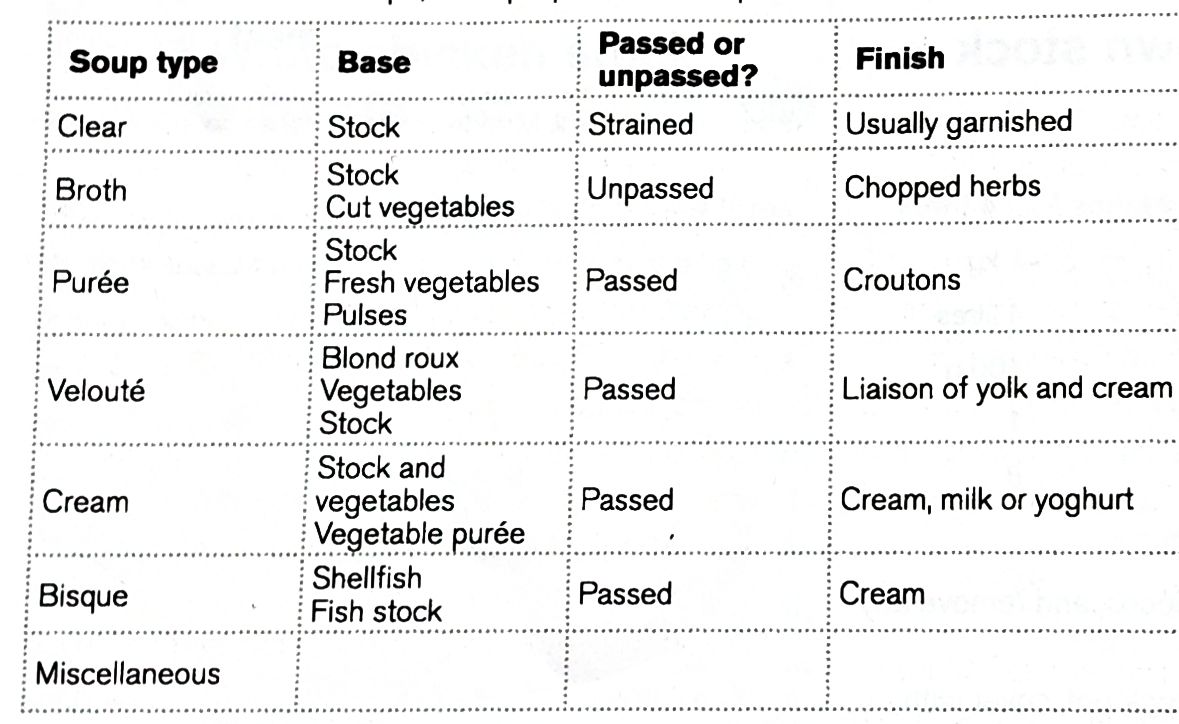
Types of soup
1) Bisque: a very rich soup with a creamy consistency;
usually made of lobster or shelifish (crab, shrimp,
etc.).
1) Bouillabaisse: a Mediterranean fish soup/stew, made
of multiple types of seafood, olive oil, water, and
seasonings like garlic, onions, tomato and parsley.
2) Broth: an unpassed soup containing vegetables and
sometimes meat or fish (e.g. Scotch broth).
3) Chowder: a hearty North American soup, usually
with a seafood base.
4) Consommé: a clear, unthickened soup, with an
intense flavour derived from meat or fish bones, or
even a vegetable base, and a good stock, clarified
by a process of careful straining.
5) Cream: based on a veloutéor purée, and finished
with cream.
6) Dashi: the Japanese equivalent of consommé; made
of giant seaweed, or konbu, dried bonito and water.
7) Gazpacho: a Spanish tomato-vegetable soup served
ice cold.
8) Minestrone: an Italian vegetable-based soup.
9) Potage: a French term referring to a thick soup.
10) Puréed soup: a soup of vegetable base that has
been puréed in a food mill or blender; typically
altered after milling with the addition of broth,
cream, butter, sour cream or coconut milk.
11) Velouté: a velvety French sauce made with
stock; synonymous with soup in many cases and
thickened with a liaison (see thickenings, below).
12) Vichyssoise: a simple, flavourful puréed potato
and leek soup, thickened with the potato itself.
Traditionally this is leek and potato soup, if served
hot a little cream or crème fraiche may be added to
give a richness to the soup; however, served cold, ít
is classified as vichyssoise and if fat is added to this
preparation the dish would leave a fatty residue on
the palate and offer a less than clear mouth feel
Soups may be served for luncheon, dinner, supper
and snack meals. A portion is usually between 200
and 250 ml, depending on the type of soup and the
number of courses to follow.
 Site Title